Tuesday, February 11, 2020

HESI Comprehensive Review for the NCLEX-RN® Examination
HESI Comprehensive Review for the NCLEX-RN® Examination


HESI Comprehensive Review for the NCLEX-RN® Examination


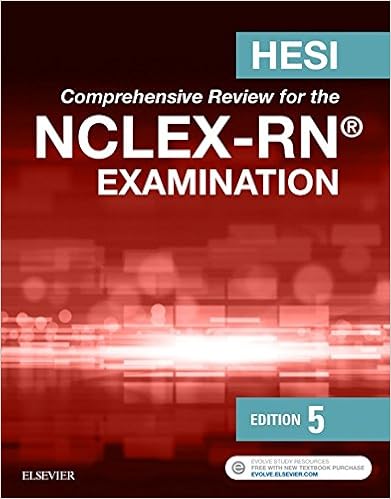
Want to cover EVERYTHING on the NCLEX-RN? HESI can help! The HESI Comprehensive Review for the NCLEX-RN® Examination, 5th Edition provides a comprehensive, all-in-one review of the information you need to know to not only succeed on the NCLEX-RN exam but also on your program’s HESI exit exam. Written in an easy-to-read outline format, this trusted guide breaks down chapters by clinical areas and the concepts emphasized on the NCLEX-RN exam. Rationales are provided for any incorrect answers or areas of weakness to help strengthen your understanding. The companion Evolve website also offers 700 practice questions in both study and exam formats to give you valuable practice using the same electronic testing format you will face on the nursing school exit exam and on the NCLEX-RN exam.
  • 700 NCLEX practice questions on the companion Evolve website include alternate item formats to provide a testing experience similar to the exit and NCLEX exams.
  • Chapters organized by clinical area enables you to easily search for various topics to review.
  • HESI Hint boxes spotlight important clinical information and concepts commonly tested on the NCLEX-RN exam.
  • Critical thinking study questions (with rationales) reinforce key concepts and content.
  • Fill-in-the-blank and prioritizing questions mirror the new alternate item format item types included on the NCLEX-RN exam.
  • Pharmacology tables highlight the need-to-know drug therapy content emphasized on the NCLEX-RN exam.
  • Consistent format and chapter organization make it easy to move between topics when reviewing.
  • NEW! Updated content reflects the latest NCLEX-RN test plan.
  • NEW! Updated medications and nursing interventions have been added based on the latest evidence-based practice.
  • NEW! Revised chapter on pediatric nursing includes an updated immunization chart, referral websites, and new content on children with disabilities and chromosomal and genetic syndromes.
  • NEW! Revised chapter on maternity nursing features updated CPR guidelines and medications for neonatal cardiac arrest, as well as new HESI Hints that reflect new modalities such as fetal cell-DNA analysis and current screening tools.
  • NEW! Revised chapter on psychiatric nursing includes new information on autism spectrum disorders, as well as updates on DSM 5 changes.
  • NEW! Revised chapter on geriatrics features new content on polypharmacy in the elderly, the Geriatric Depression Scale as an assessment tool, the Mini-Cog tool for mental status assessment, and new information on elder mistreatment in various settings.

Teaching in Nursing: A Guide for Faculty

Teaching in Nursing: A Guide for Faculty


Teaching in Nursing: A Guide for Faculty


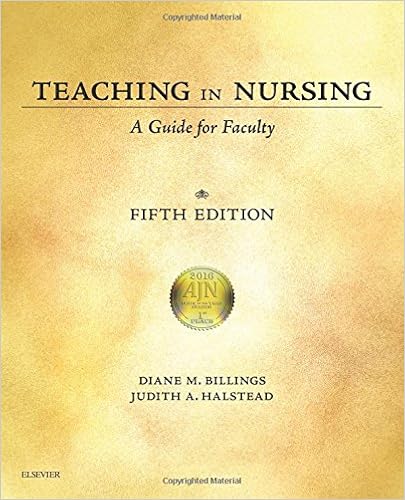
Set yourself up for success as a nurse educator with the award-winning Teaching in Nursing: A Guide for Faculty, 5th Edition. Recommended by the NLN for comprehensive CNE prep, this insightful text is the only one of its kind to cover all three components of teaching: instruction, curriculum, and evaluation. As it walks through the day-to-day challenges of teaching, readers will benefit from its expert guidance on key issues, such as curriculum and test development, diverse learning styles, the redesign of healthcare systems, and advancements in technology and information. This new edition contains all the helpful narrative that earned this title an AJN Book of the Year award, along with updated information on technology-empowered learning, the flipped classroom, interprofessional collaborative practice, and much more.
  • Coverage of concept-based curricula includes strategies on how to approach and implement concept-based lessons.
  • Extensive information on online education discusses the use of webinars and other practical guidance for effective online instruction.
  • Evidence-based teaching boxes cover issues, such as: how to do evidence-based teaching; applications of evidence-based teaching; implications for faculty development, administration, and the institution; and how to use the open-ended application questions at the end of each chapter for faculty-guided discussion.
  • Strategies to promote critical thinking and active learning are incorporated throughout the text, highlighting various evaluation techniques, lesson planning insights, and tips for developing examinations.
  • Updated research and references address forward-thinking approaches to education and trends for the future.
  • Guidance on teaching in diverse settings addresses topics such as the models of clinical teaching, teaching in interdisciplinary settings, how to evaluate students in the clinical setting, and how to adapt teaching for community-based practice.
  • Strong focus on practical content ― including extensive coverage of curriculum development ― equips future educators to handle the daily challenges and opportunities of teaching.
  • NEW! Chapter on Interprofessional Education and Collaborative Practice focuses on the collaboration of care across patient care providers, emphasizing clear communication and shared patient outcomes.
  • NEW! Renamed unit on Curriculum as a Process better reflects the latest QSEN competencies and other leading national standards.
  • NEW! Renamed unit on Technology-Empowered Learning covers the use of technology for learning ― including non-traditional course formats, active learning, flipped classrooms, and more.